
30 August 2026
When the handbook invite never arrives
Someone asks who has signed the current handbook. You open the campaign and see confirmed, outstanding, a few exemptions. Then you notice the outstanding pile includes people who never clicked anything, because they never got the email. The reminders went to the same place. The version is right. The audience is right. The ask simply did not land.
An acknowledgement is a named person confirming a specific version of a document. If the invite and the reminders do not arrive, that confirmation cannot happen. You are left reconstructing a story from an inbox and a spreadsheet, and hoping the missing people will chase you. That is a poor thing to hand over when someone asks for evidence.
Handbooks move. People join and leave. An information-security policy gets a new version and needs a fresh round. The workflow only holds if the mail that starts it actually arrives: the first send, then the reminders, without silent gaps and without two copies of the same invite landing a couple of hours apart.
Policyflow already does the part after the click. Recipients open a link, read the version they were sent, and confirm. You export name, version, and time. Until 30 August 2026, campaign email was the weak link in that chain. If a send hiccuped, the message could disappear, or it could go out twice. Either way, the acknowledgement trail starts in a mess.
That is what we changed. Campaign email is now written once and then sent. A glitch does not lose the send, and it does not double it. Invites, reminders, report emails, and follow-ups all go through that path.
The campaign list now shows more about whether mail reached people. So do the deliverability settings. If you are connecting a sending domain, the in-app deliverability test still goes out immediately, so you can check the domain before you roll a campaign to everyone in scope.
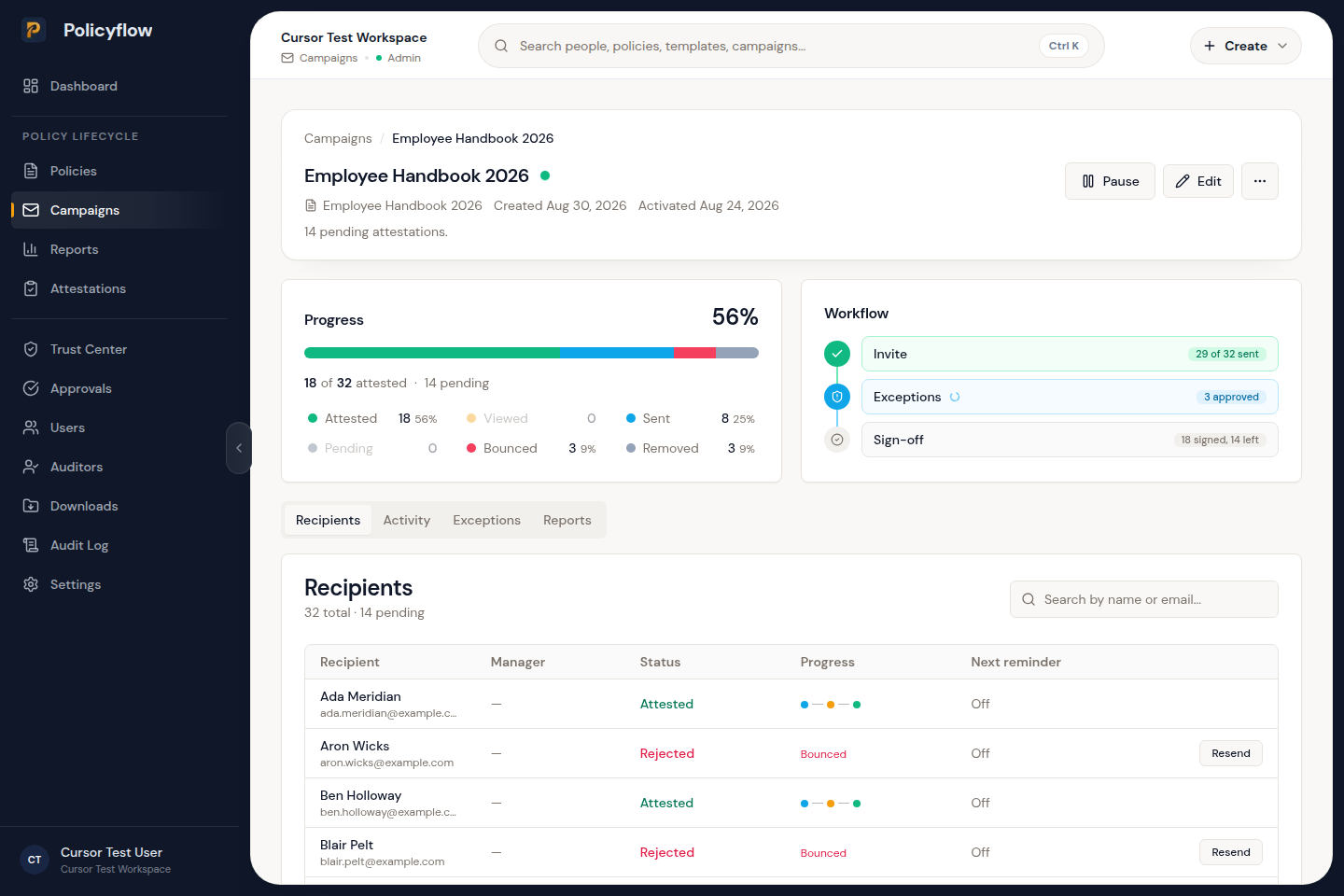
None of this writes the handbook for you, and it does not make anyone confirm who never received the link. It does mean the send is no longer the part that fails quietly while the rest of the workspace looks fine.
If you have a current handbook or an information-security policy sitting in a shared drive, send it through Policyflow. Put the live version in, pick the people who need to sign it, and let them confirm in the browser. When someone asks who signed that version, you export the list instead of assembling it.
Free forever up to 15 employees. No card, and no time limit. If you outgrow that, Core starts from €55 a month billed annually.